

By Mary Graves
My stories from a recent visit to the West Bank are mostly heartbreaking, except for the stories about art and culture. Many gifted Palestinians are investing heavily in their art and design and dance as a source of identity, hope, and joy. One of our favorite examples of this was our time with the dancer Hanna.
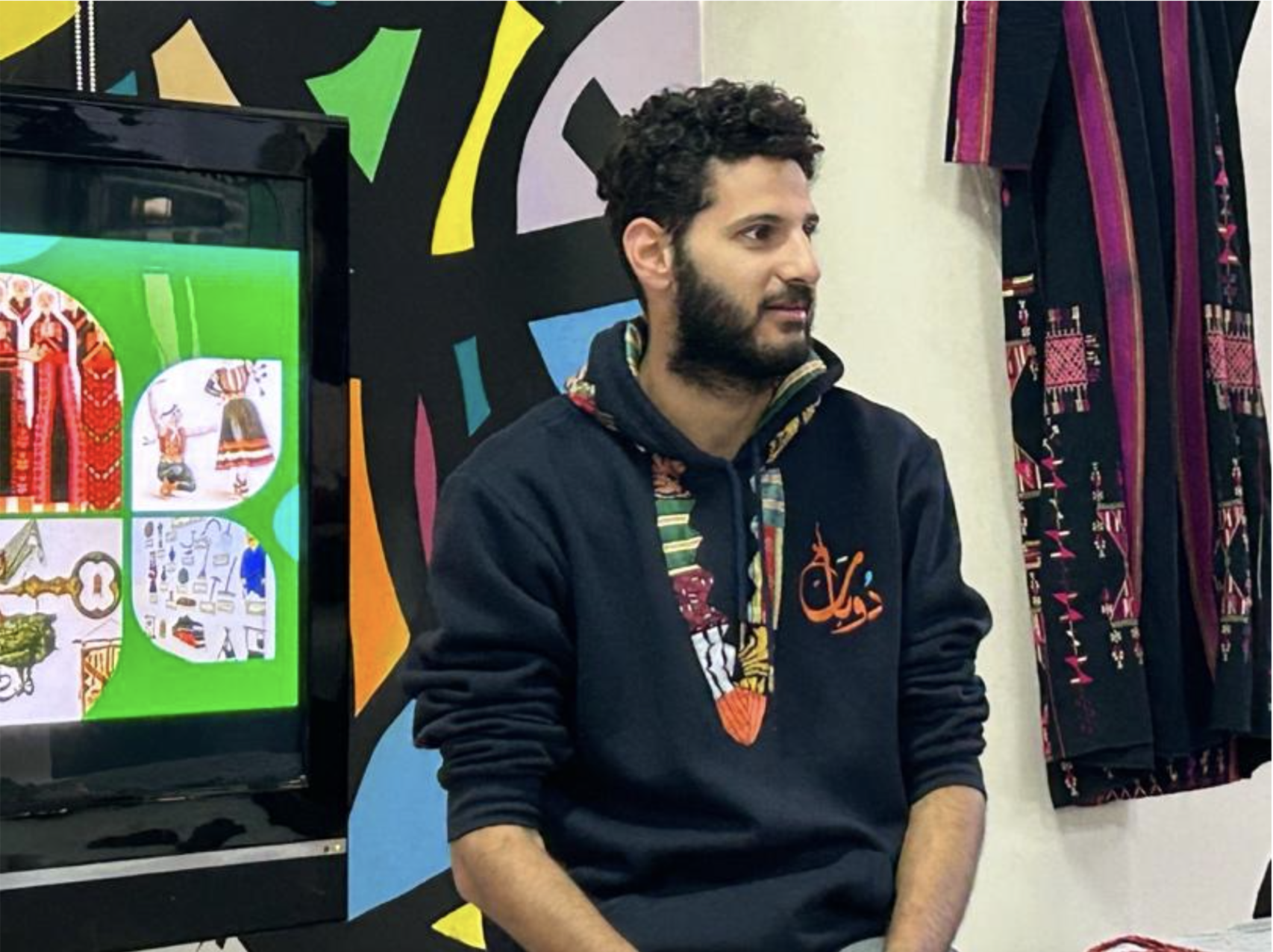
Hanna is tall and handsome and looks like a dancer. He grew up in Jerusalem under the Jim Crow-type life that regularly limits and demeans Palestinian youth there, and he soon discovered a positive way to deal with his anger by learning how to dance from his sister’s dance lessons. At first, he was an Olympic-class swimmer, but when he was told that he would have to become an Israeli citizen to compete in the Olympics, he refused. (Palestinians in general are not allowed citizenship.) Instead, he learned Palestinian folk art and dance and became an expert in these.
Our delegation of 15 people was seated in a semi-circle around his mirrored dance room with beautiful Palestinian garments hanging on the walls, while Hanna gave us a mini orientation on how generations of Palestinians wove art designs into their garments to tell their stories and share their identities. As he talked through his PowerPoint presentation, a small pug dog in a little dress made her way from person to person, sniffing each pair of shoes. I think she was deaf and maybe a little blind. We were curious about her until she just became a part of the scenery.
Eventually, Hanna got us on our feet to teach us a few dance steps and their symbolism. It was like trying to learn some tricky line dancing, and the skills of our group ranged from pitiful to pretty good. We then begged him to share one of his choreographed pieces with us. So, he turned on a traditional piece of music, began to move his legs and shoulders in rhythm, and off he went into this amazing three-minute dance. I’m so glad I caught it on video, because it is the delightful way I end all my storytelling about the West Bank.
Hanna said, “I used to want to be the best dancer, but now I want to teach our children these dances.” Since he knows what a positive outlet dance can be, he goes into the schools and neighborhoods of traumatized children and starts folk dance programs there. “The average Palestinian child in Jerusalem,” Hanna said, “has less than one meter to play in.” So now he spends most of his days giving them a way to move and play that brings pride and joy.
Our delegation also had the chance to visit a new school campus in Bethlehem called Dar al-Kalima University, and we met with its founder and president, Rev. Dr. Mitri Raheb. He talked about the university’s focus on art, culture, and design as a way of bringing transformation to the landscape of Palestine. Two thirds of the students are women, learning empowerment and gender justice. The school itself was designed and built by Palestinians and provides jobs where one in three people are unemployed.
“Why not start a seminary here?” he had been asked. “We have too much religion…,” was Mitri’s response, “too much politics.” So, this Palestinian pastor and theologian turned to art and culture and design and jobs as a way of bringing hope and change.
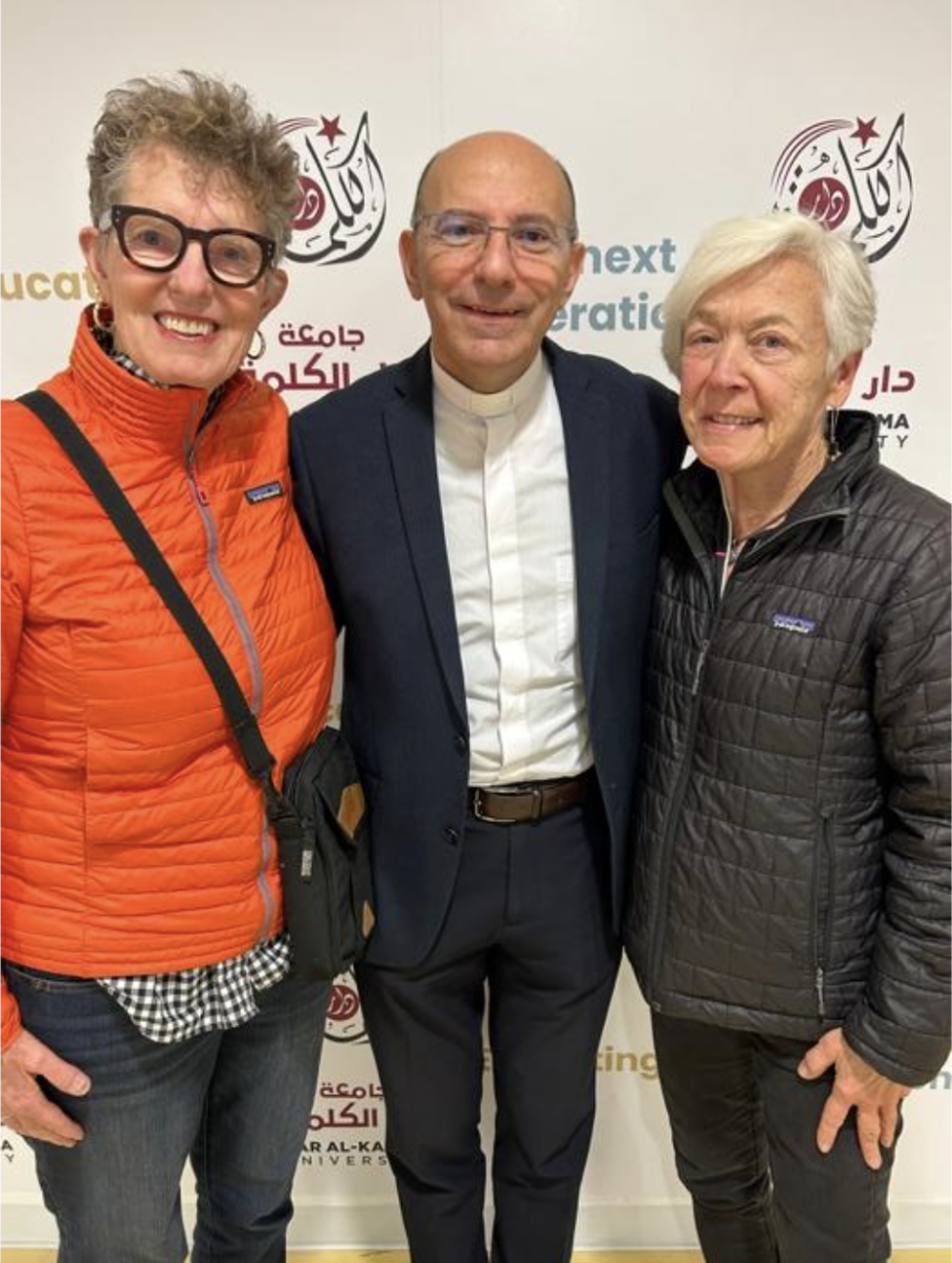
Two delegation members, Rev. Dr. Heidi Armstrong (L) and Rev. Dr. Mary Graves (R), standing with Rev. Dr. Mitri Raheb, founder and president of Dar al-Kalima University
I was so surprised and moved when I found out that Rick Steves decided to support the work of Dar al-Kalima University by making Palestine his valentine this year. He used Valentine’s Day as an opportunity to raise $50,000 to help build a garden and café on Dar al-Kalima University’s West Bank campus, “and to help build community for a generation of young Palestinians.” The cost of the project is $150,000. The school had $50,000 already, and he pledged to match the first $50,000 in gifts from his community of travelers. Why did he do this?
Like so many caring Americans, I often wonder, “What can I do to help the heartache in the Holy Land?”
… For years I’ve had the privilege of hearing the stories of young people who have been impacted by the work of Bethlehem’s Dar al-Kalima University – not from a distance, but in person on my last visit to Palestine and through the school’s founder and president (my friend Rev. Dr. Mitri Raheb) and its students, artists, and educators.
… this Valentine’s Day project… honors people, preserves culture, and brings hope to a land where hope can be a foundation for peace.
Last year Rick Steves did a similar “Palestine is my Valentine” match gift of $100,000 to raise more than $250,000 to help rebuild the bombed-out branch of Dar al-Kalima University in Gaza, and everything is now in place for that work to break ground as soon as circumstances allow. “That generosity wasn’t abstract,” said Steves, “It was deeply human. It was love, made practical… It’s a commitment – to people, to place, and to the belief that education and culture are acts of hope.”
Rev. Dr. Mary G. Graves is a retired Presbyterian pastor and spiritual director in the San Francisco Bay Area.