

Haifa: A Mixed City
By Jan McDowell
In the midst of all our profoundly moving experiences, we started off our day on Friday, January 16 with a reminder that our processes are human. A communications glitch caused a brief stir.
Our printed agenda said that we would depart on the bus for Haifa at 8:30am. At 7:15, I saw a Signal chat message from Dana, our wonderful Sabeel host for the day, saying that she would be at our guest house at 7:30. I responded asking if we would still be leaving at 8:30? She said no, we needed to be gone by 7:40! At that point, some of our delegation were likely still asleep! After multiple hasty messages, we compromised on meeting the bus at 8:00.
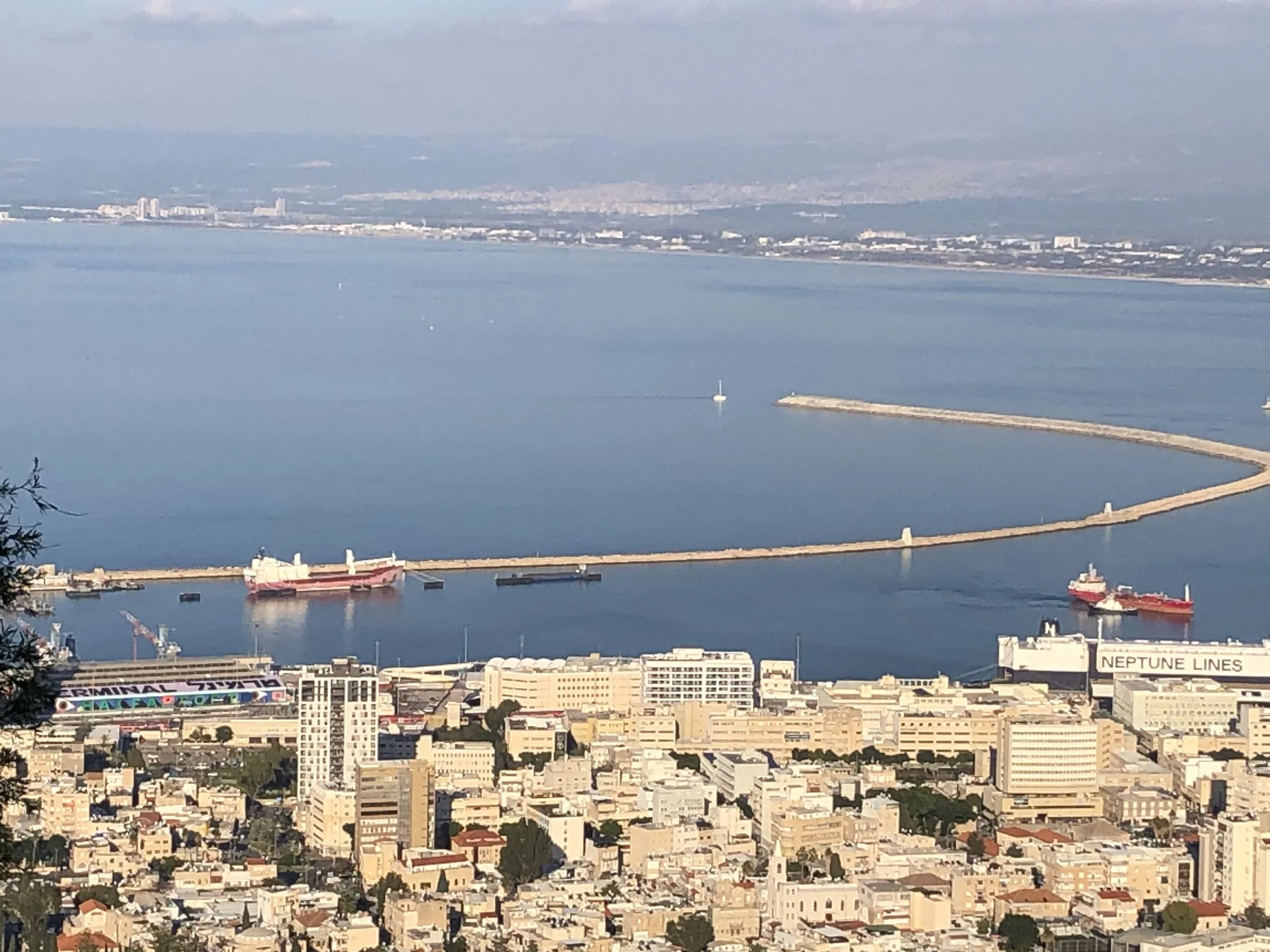
Then we were off to Haifa. We learned that Haifa is one of five “mixed cities” in Palestine. Even for some of the more knowledgeable members of our delegation, this was a new facet of the confusing structures in the West Bank.
Throughout most of Palestine, populations are either almost exclusively Jewish or almost exclusively Arab. But in the five mixed cities, the population, while the vast majority is Jewish, is 10% or more Arab. Haifa is approximately 12% Arab, though figures are hard to pinpoint. Within Haifa and the other mixed cities, however, housing is largely segregated. According to the New York Times, even towns "portrayed as models of peaceful coexistence fester with resentments born of double standards."
Haifa is a large city, very modern in comparison to Jerusalem and other areas we visited earlier in our trip. The population is about 300,000.
Our first stop was at the Social Development Committee. It was established in 1982, and their mission is to strengthen and empower the Arab community in Haifa. Speakers emphasized their focus on education, and on their efforts to provide books for children. They have concentrated on supporting teachers and more modern teaching methods.
Schools are segregated. Jewish schools are for secular, orthodox and religious Jews. Arab schools are for Chrisian and Muslim students. After-school centers are an example of the apartheid that’s evident everywhere. There are Jewish centers, and Jewish-Arab centers. In both, Hebrew is spoken. There is no Arab center.
We learned that, by law, the municipality must publish plans to all, in many languages. Unfortunately, the Israelis do not follow that law, so there is no input from Arabs in governing the city.
Another reality for many Arabs that we learned about was the “key rental law.” During the Nakba (catastrophe) in 1948, many Palestinians were forced out of their homes. Shortly thereafter, the Israeli government conducted a survey, and obviously found many homes and properties abandoned. Under their “Abandonment Act”, the government declared them voluntarily abandoned, and thus now the property of the state. Even now, 78 years later, the former owners are required to pay “key rental” to live on property that has been in their families for generations. While they may live there, they are not permitted to sell the properties, or to bequeath them to their children. It was stunning to hear this story over and over, from many of the people who spoke to us throughout our time in the West Bank.
One story we heard was of a friend who worked for 30 years in a hospital in Haifa. She posted on Facebook, including the phrase, “God bless the people of Gaza.” Based on that, she was fired, deemed unfit to work in the Haifa hospital. Another Palestinian man was arrested for posting a picture of a man, sitting in rubble in Gaza, with a broken heart emoji.
Since the October 7, 2023 Hamas attack, Israel has provided about 150,000 weapons to settlers “to protect themselves,” especially in the mixed cities. Prior to that, Israelis and Arabs had lived peacfully as neighbors. We heard of one Arab man who had helped his Israeli neighbor. The neighbor called him a brother. But when the Arab man called for all the neighbors to come together during this time, only the Arabs showed up.
When Jews came at the Arab man with rocks, even a woman he had called “Grandma” closed her windows and made no attempt to help him.
In spite of everything, our speaker said that it is his hope that the mixed city can be a shared city.
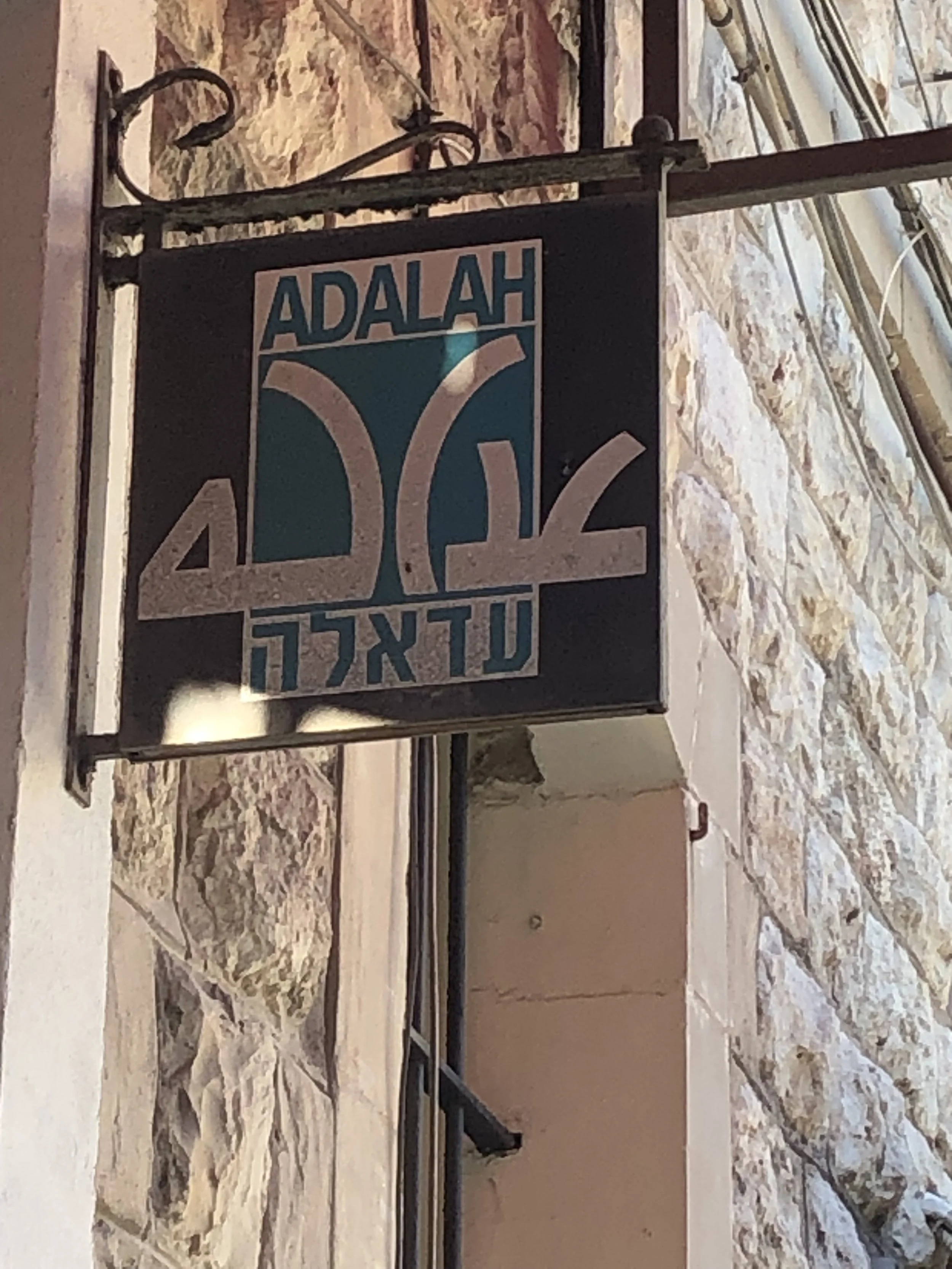
Our next stop was at Adalah (pronounce a-dah’-la), which means justice in Arabic. It is an independent human rights organization and legal center. Their mission is to promote human rights in Israel in general and the Palestinian citizens of Israel in particular. Adalah is the only Palestinian organization that works before Israeli courts to protect the human rights of Palestinians in Israel and in the Occupied Palestinian Territories.
Those courts are far from impartial. We were told of a judge who said that Palestinians should think before doing anything against a Jew, because they’re in a Jewish state.
Since the 1967 Israeli attacks which set off the 6-Day Arab-Israeli War, the governing structure in the area is based on Israeli civil law for Israelis, and military law in the West Bank.
One manifestation of the discrimination that Palestinians face is the preference given for jobs and mortgages, based on military service. The catch is that Palestinians are not accepted into the military, so they are automatically at a disadvantage.
We ended our day with a tour of the the city of Haifa. It is truly a wonder of contrast between old and new, Israeli and Palestinian.
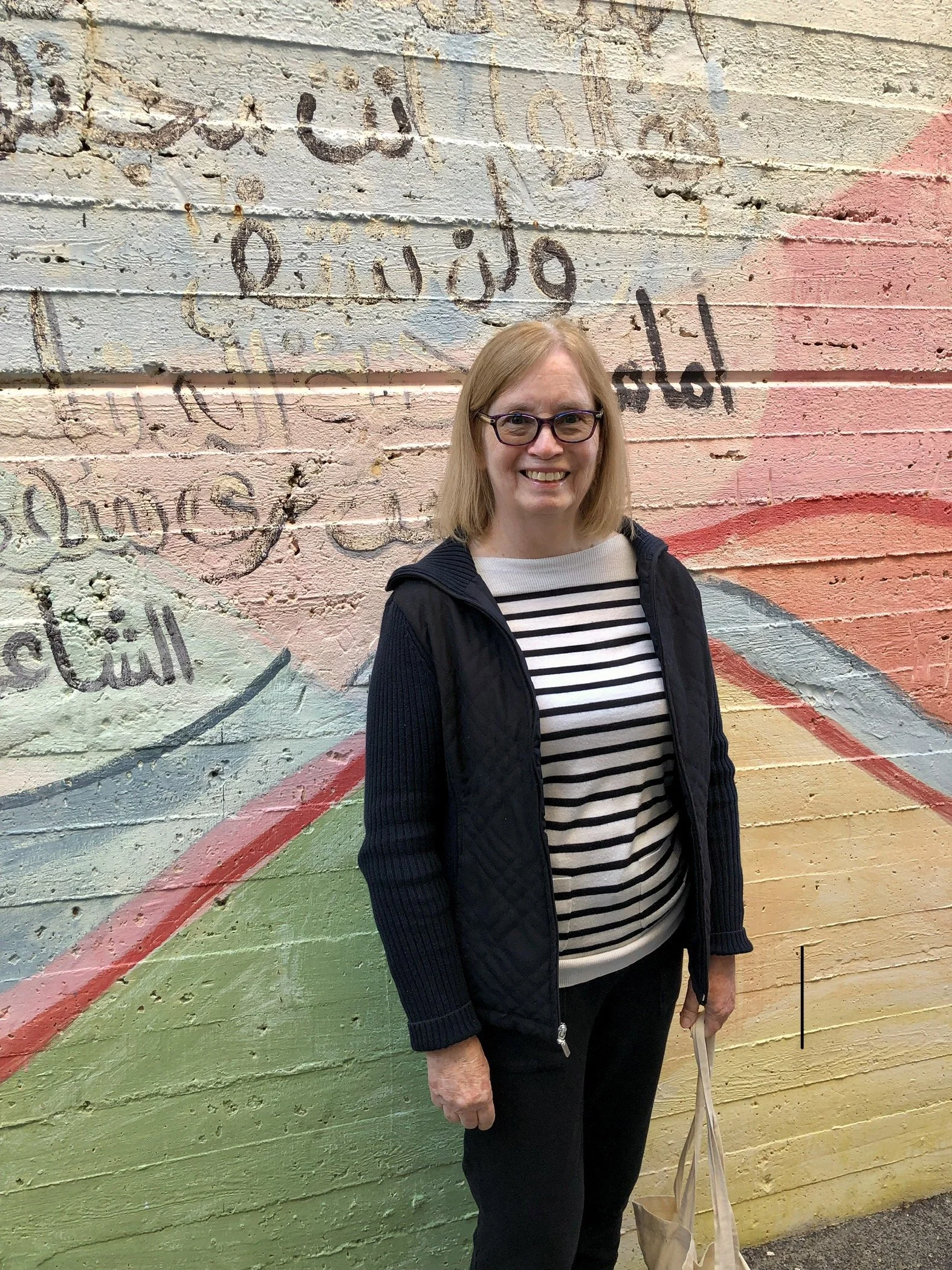
I have been politically active since 2010. I began as a Democratic precinct chair, then served
as treasurer of the county party, and then I was a candidate for Congress in multiple election
cycles. One time, I came close to winning the seat in my very red area of North Texas!
As a Unitarian Universalist, my platform was always rooted in the first UU principle, a belief in
the inherent worth and dignity of every person. I combined that with my background as a
retired CPA to advocate for an economy that truly works for all.
I’ve done my best to be informed about the issues that are important to people, and to speak
out on the side of ALL the people, not the few. I’m determined that we can make this world
better for ALL.
I was born in Pittsburgh, PA, but my family moved to the Dallas, Texas area when I was 8-
years-old, and I’ve been here ever since. I’m a fan of lifelong learning, so being a part of this
delegation was an incredible learning experience for me!