

By, Ailih Weeldreyer
In January 1997, two young, white, American Christians from Michigan and North Carolina traveled from Union Presbyterian Seminary to the Holy Land, and were transformed. My parents witnessed apartheid amidst visits to holy sites, and were invited into conversation with Palestinian Christians from Sabeel. Disturbed and touched by the experience, their perspectives were changed. Later that year, I was born. Unlike many white, Christian Americans in a culture that is by default Zionist, I grew up with the word Palestine, with the knowledge of the occupation, and with a faith that encouraged me to be in solidarity with Palestinians. In January 2026, I made the same journey to Palestine. My time there has left me transformed in the way that we are called as Christians to continuously turn toward God. I have turned back towards a knowledge I have had since birth, and will orient my life towards it going forward.
I am a testament to the power of the stories and ideologies we learn as children. My parents’ stories and those of the Palestinians they invited into our home were formative for my worldview before I could even fully understand them. In the same way, Israeli and Palestinian children are formed by their environments and the stories they are told. I and others in our delegation were struck over and over by the ways that children are taught, either to become oppressors or to resist oppression.
On January 19, we visited the Tent of Nations, Bethlehem, the Walled Off Hotel next to the apartheid wall, and Aida refugee camp. At the Walled Off Hotel there is a museum which documents the occupation and Palestinian resistance, with barred windows overlooking an expanse of concrete. In this museum, there are artifacts that illustrate the ways that Israeli children are taught from birth to respond to the world around them with violence. An Israeli Defense Force onesie was displayed next to an elementary counting worksheet with cartoonish tanks and fighter planes. In a video sharing testimonies of soldiers, one recalled, “At 18 years old I was given a button, a big red button…You press that button and 4 kilometers away someone will die.” Another recounted, “I gave up on humanity, I gave up on who I am and just became more and more aggressive, to become a part of the society where I live.” Earlier in the week, two settler children shouted slurs at one of our Palestinian guides as he showed us the now-deserted streets of his home in occupied Hebron. I am deeply saddened for the children who are raised to be violent, taught to abuse people simply for their identity, and deeply concerned about the effects such a society has on the rest of the world.
Our journey to the Tent of Nations was circuitous and brought us through “Area C” of the West Bank, where settlers are taking as much land as they can from Palestinians. The farm, which now serves as a faith-based community dedicated to nonviolent action, sits on a hill not far from Bethlehem which is the only hill in the region without an Israeli settlement. The farm is owned by the Nassar family, and we were privileged to speak with Daoud Nassar, who leads his family’s resistance to the attempts by Israel to take their land. For thirty-five years, the Nassar family has been in court with the Israeli government. Their orchard and olive trees have been destroyed and they have received 28 demolition orders despite holding documentation for their land from the state of Israel. Despite the constant threats from settlers and the state, the Nassar family remain steadfastly committed to their principles:
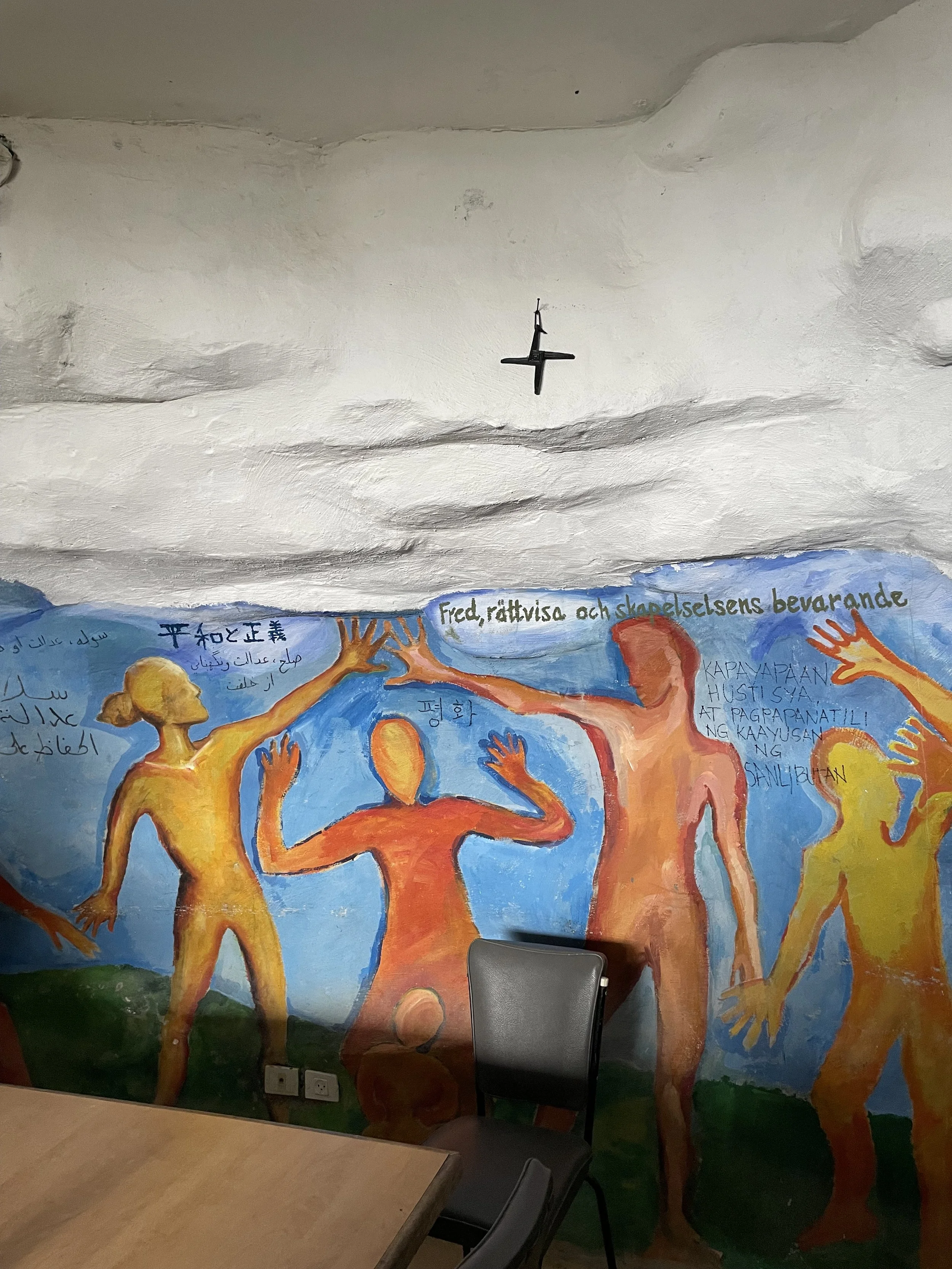
The walls of a cave classroom at the Tent of Nations is adorned with a peace mural made by children, showing their shadows and wishes for peace.
We refuse to be victims
We refuse to hate
We act on our faith
We believe in justice
They mirror those articulated by Sabeel as the foundation of Palestinian Liberation Theology:
Inclusivity
Prophetic voice for justice
Nonviolence
At the Tent of Nations, summer camps welcome children from the surrounding community to teach them to be connected to their land and to demonstrate the value of nonviolence. All people who spend time there are taught to treat farming as a form of therapy - when feelings of rage and hatred arise, they are encouraged to work the land instead of acting on those emotions. Daoud shared with us their vision for the future: they want to create an environmental education center at Tent of Nations. He described a thriving center of community where people, especially children and youth, could learn about the science of conservation and how to care for their ancestral land. These are powerful examples of theology in action for Christians to aspire to, and to model in our communities for the younger ones who are learning how to understand the world.
The day I returned from Palestine, my heart was broken again by the murder of Alex Pretti in Minneapolis. I am struck that those scenes of violence mirror those in the West Bank, and it emphasizes to me the way the violence of empire is entwined across borders. In Palestine as much as in Minneapolis and our own communities, Christians have an obligation to speak up and stand in the way of empire. We must be a prophetic voice in this time, or - as Rev. Munther Isaac reminded us on Sunday - we render our churches and our messages of faith irrelevant. At the Church of the Nativity in Bethlehem, the main entrance to the church is kept intentionally short to require pilgrims to bend down before God. Entering the church, I was viscerally reminded of the humility necessary to admit our complicity with the sins of the world before God and our siblings facing oppression, apartheid, and genocide. May we all find this posture of humility and allow it to move us to action.
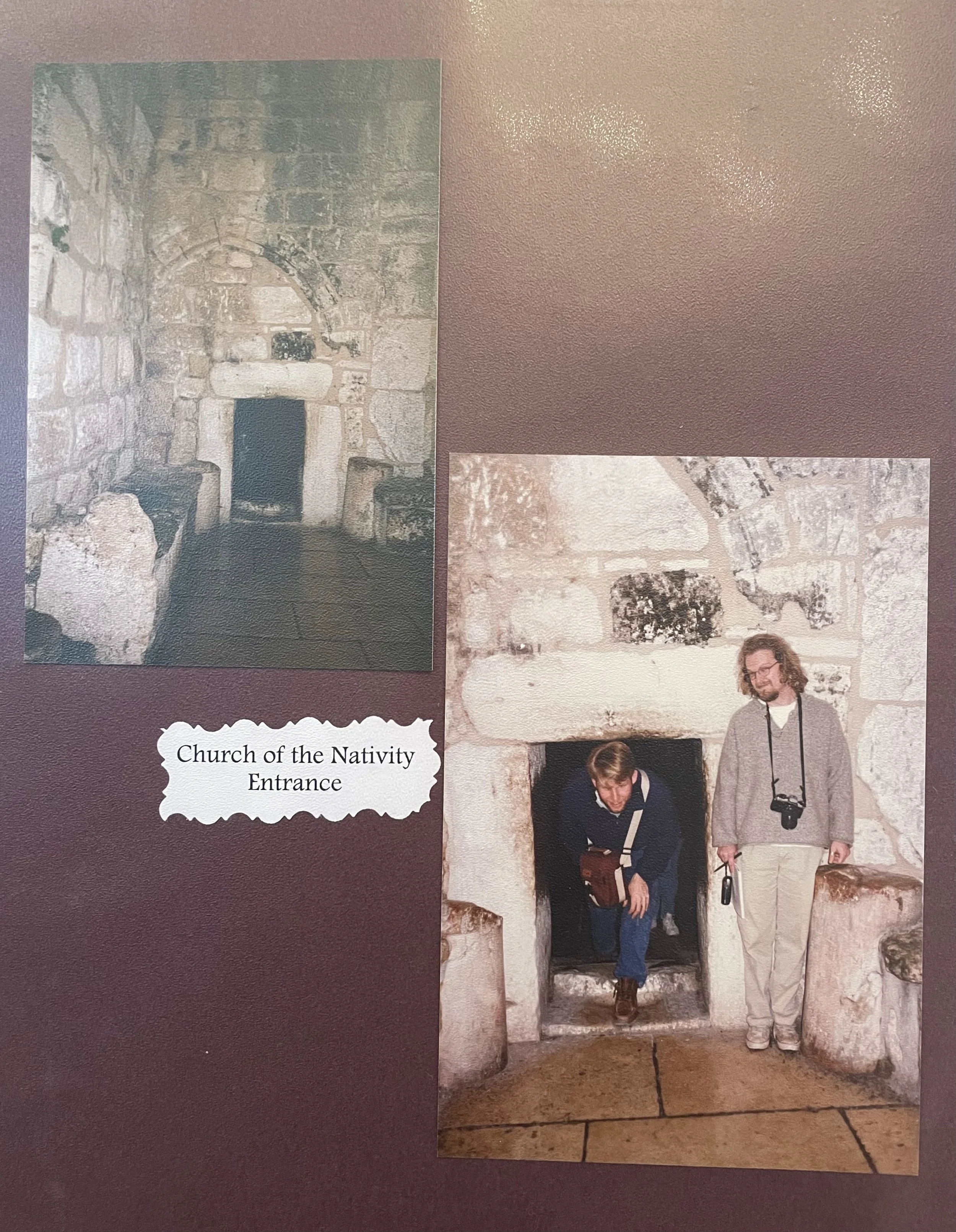
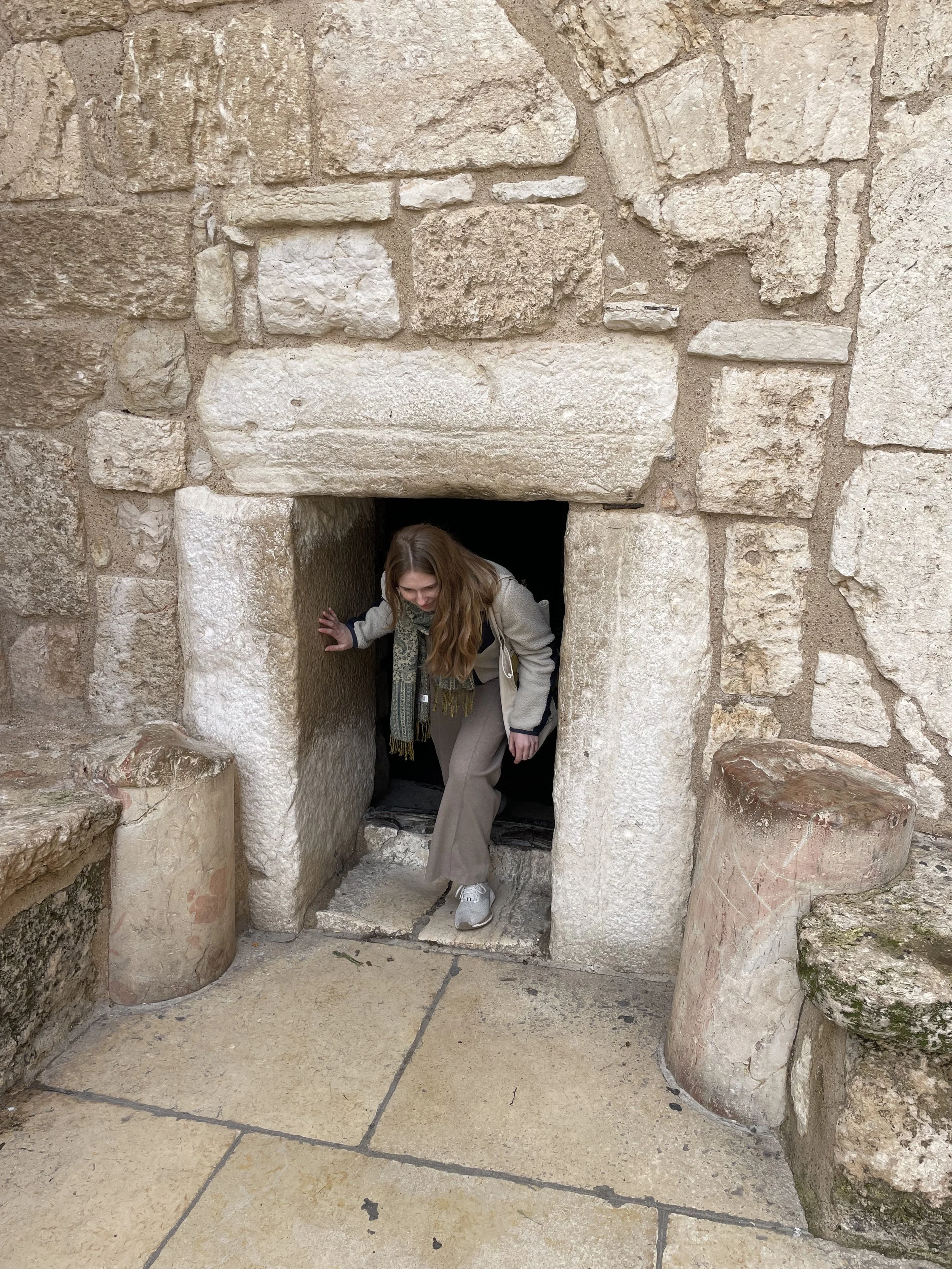
On the left, in 1997, Ailih’s dad (Seth Weeldreyer) exits the Church of the Nativity. On the right, Ailih exits in 2026.
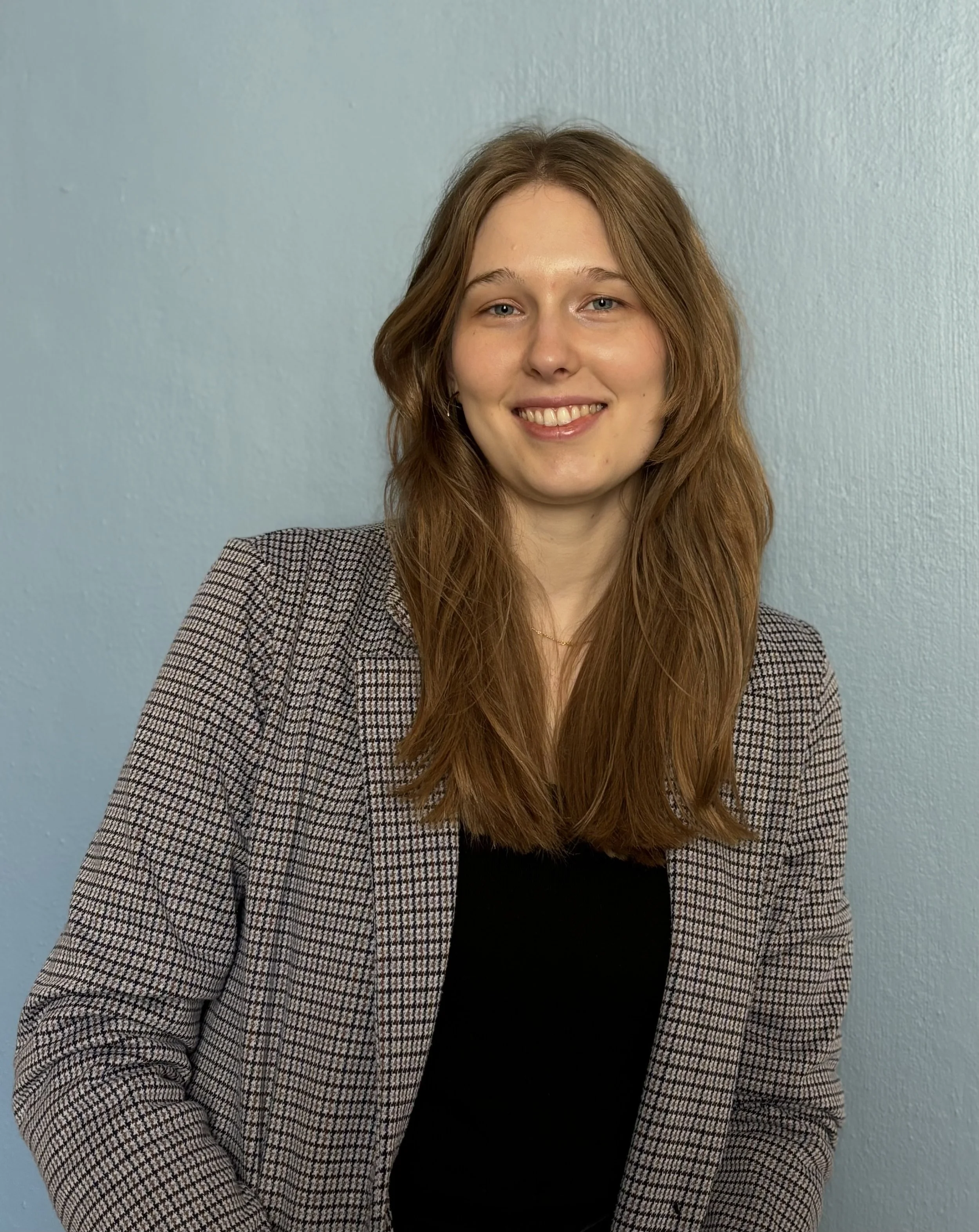
Ailih Weeldreyer (she/her) is the National Organizer for the World Student Christian Federation-US and a 2024 graduate of Harvard Divinity School. She has served on the staff of the Quaker United Nations Office, as a Presbyterian Young Adult Volunteer in Washington, D.C., and organized with the Sunrise Movement in her hometown of Kalamazoo, Michigan. Her professional, volunteer, and academic work, as well as personal history, connects her to efforts for peace in Palestine, the Korean Peninsula, and Scotland.