

By, Henri Acree
In 1999, before I was born, my parents visited Jordan. They obtained water from the River Jordan, water which would, a few short years later, be used to baptize me into the Presbyterian Church (USA). In December of 2025, my mother and I returned to Jordan. This time, we were passing through on our way to Occupied Palestine. The River Jordan, when we crossed it as part of that journey, had slowed to barely a trickle, with 90% of its flow redirected for agricultural, industrial, and urban use in settlements in Israel and surrounding regions. The Water of Life has been systematically diverted away from the Palestinian people.
Historically, access to water has determined where people live (trust me, I study anthropological archaeology). Settlement patterns can be mapped, the paths of nomadic communities traced, by where there is life-giving water and by extension the capacity for agriculture and livestock maintenance. Today, though, the Palestinian people’s towns and the formerly nomadic Bedouin communities of the area are restricted by border demarcations, military checkpoints, and forced resettlements in Israeli-controlled townships.
Control over water resources remains an important aspect of apartheid maintenance in Occupied Palestine; in a recent Al Jazeera article, Jad Isaac, the director of the Applied Research Institute in Jerusalem, revealed that Israeli settlers had access to and used, on average, seven times the water of Palestinian citizens. The Palestinian individual receives no more than 80 liters a day, with many individuals receiving far less – as low as 15 liters, or 4 gallons. The global minimum recommendation, Isaac continued, is 100 liters a day. Israel has taken full control of water access, forcing Palestinian communities and the Palestinian Authority to buy water, often at or above market price, from Israel. For a community that is already being bled dry, this is unsustainable.
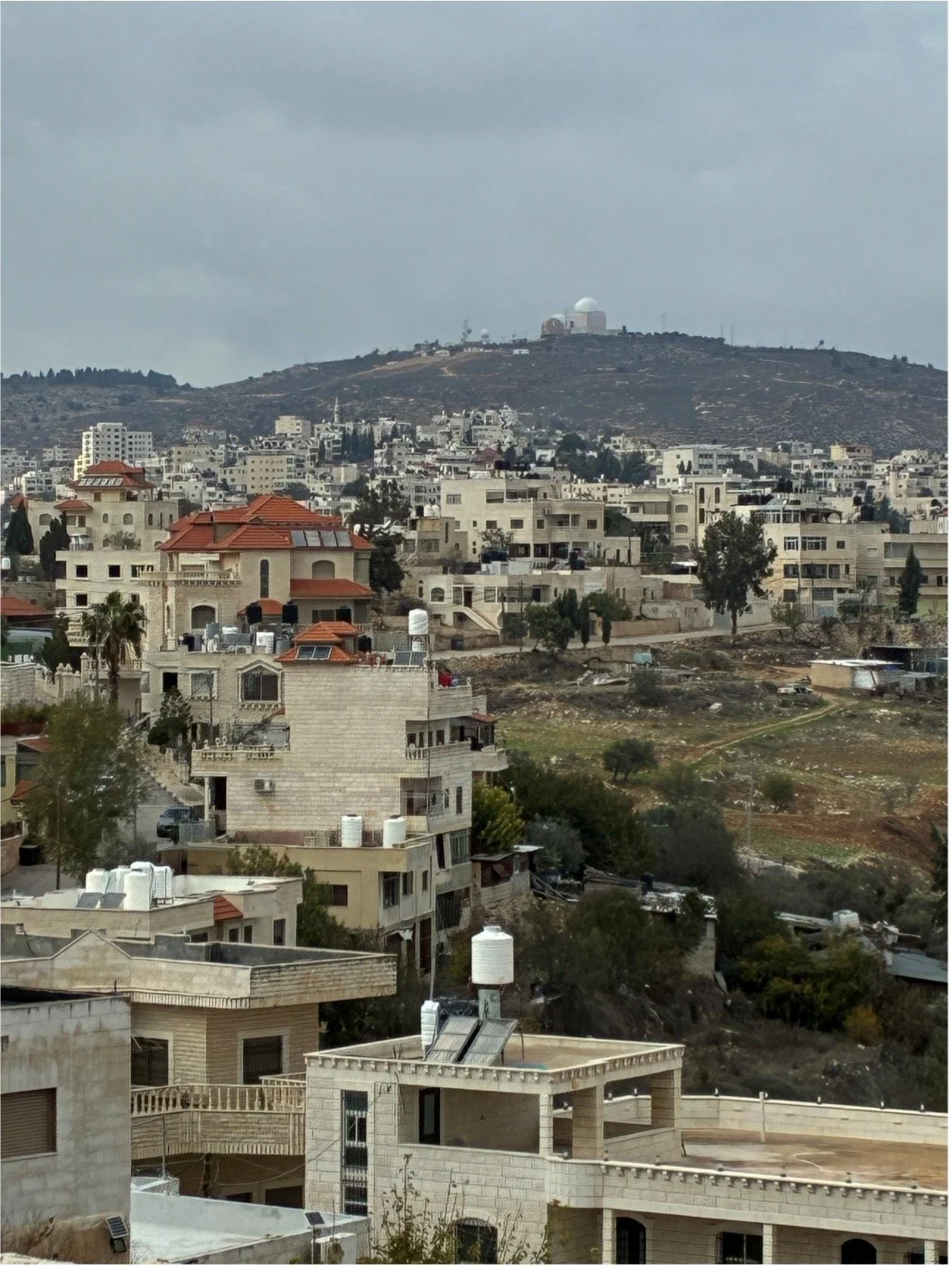
[Image: homes with plastic water tanks visible on the roofs, under the surveillance of an IDF outpost on the top of the hill.]
As we drove through the area for the first time, crossing over from Jordan and traversing the South Hebron hills on our way to Jerusalem, a member of our group asked how to differentiate between settler homes and Palestinian homes. The answer was simple yet sickening. Palestinian homes, we were told, have water tanks on top. This is so the residents can prolong the functioning of daily life for as long as possible when their access to water is further restricted. Note the intentional language. Not if their access to water is restricted; when. The tanks, we are told, are plastic. Some used to be metal, but Israeli settler militias and IDF members use them for target practice often (spilling out the collected water), and mending metal is difficult.
Our van passed a Bedouin community and then, further along, on the other side of a busy highway, a water pump under Israeli control. The people from that community – and from others in the area – must come to the water pump to collect water. Children are killed by cars when crossing the road, both to the pump and back. This information was imparted to us in the weary tone of a man who knew how horrifying it was, and who knew that every part of that setup was intentionally orchestrated to keep Palestinians struggling under the oppressive settler-colonial presence.
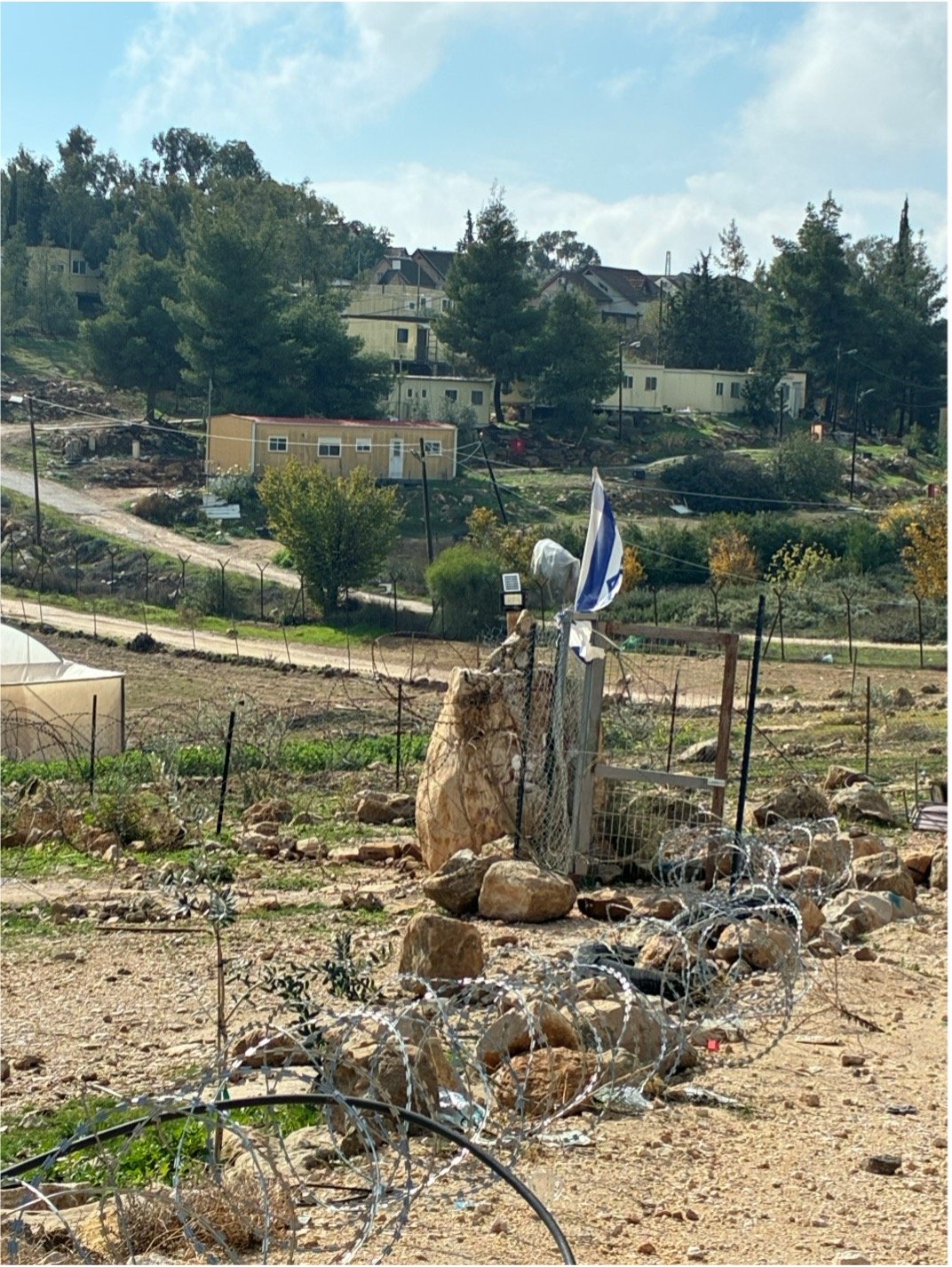
[Image: the clear delineation between Palestinian land, nearer to the camera, and land occupied by Israeli settlers, demarcated by the dual roads splitting the image. The settlers have the water resources to maintain plant life, while to the left of this photo frame, a Palestinian olive tree plot slowly withers.]
If the people can barely access enough water to keep themselves alive, the continued maintenance of crops and livestock presents yet another difficulty. The olive trees of Palestine require supplementary irrigation throughout the hot, dry summers to ensure a proper harvest. If farmers cannot keep the olive trees alive, they cannot cultivate a crop that year. Under Israeli law, if Palestinian land goes ‘uncultivated’ for three years, it can be permanently seized by the Israeli government. The seizure of land plots around Palestinian communities blockades the residents in, requiring them to cross Israeli land to reach their own farms; this is, effectively, a death sentence. The land that farmers cannot access to cultivate is then seized by the Israeli government, because it has gone uncultivated. The system is set up, intentionally, to ensure that Palestinians are systematically cut off from their neighbors and pushed off of their land to allow for colonists to move in.
Although our delegation spent our time in Occupied Jerusalem and the surrounding areas, we were able to speak with Palestinians who updated us on the situation in areas we could not enter, such as Gaza. The lives of Palestinians in the Gaza Strip are under even greater and even more immediate threat from a number of ongoing human rights violations at the hands of Israel and the IDF. Most of the water and sanitation infrastructure in Gaza has been destroyed over the past years of bombing. Aid trucks are stalled indefinitely at the border, while inside Gaza, people die of dehydration, of infection and illness because what little drinking water they can access is unclean, of preventable disease because there is no water left for sanitation practices.
Palestinians have been systematically prevented from accessing the water of life; this statement should be abhorrent to the people of God. Did God not draw forth water from a stone for God’s people in the desert? – and yet the Palestinian Christians we spoke to continue to suffer. Did Rebekah not bring water for Eliezer and ten camels, out of the goodness of her heart? And should not the people of God continue to fight for water to be accessible to everyone?
The author, Henri Acree, accompanied Rev. Bruce Reyes-Chow’s December 2025 Presbyterian delegation to Palestine. The son of Presbyterian preacher Jill Acree, Henri studies anthropology and archaeology, and is currently obtaining a Master’s degree. He currently lives in Massachusetts with his cat Indiana Jones. He is @hjacree893 on Instagram.