

Where Children are Free to Chase Soccer Balls
By Nate Paulin-Wieland
As our bus motored along the Israeli-only road through the occupied West Bank, we sang hymns and a song for Palestinian freedom. “The martyr’s blood is scented with cardamom,” one of the lyrics in Arabic went. We couldn’t deny the blood on this land. We passed Israeli settlement after Israeli settlement wondering how many were built directly on top of the villages of displaced Palestinians. Omar, our host, showed us with every stretch of highway the bone structure of apartheid; separate roads for Palestinians and Israelis, gates to Palestinian towns opened and closed at will by the Israeli occupiers, checkpoints slowing down or stopping travel, IOF soldiers patrolling with automatic weapons, and settlements with nicely paved roads and wires delivering electricity while historic Palestinian villages caught rainwater in basins for fear of the next time Israel would shut off their water supply. Without a guide our untrained eyes might have passed over it all, read it through our western lens. Much work has gone into hiding the blood that’s being spilled.
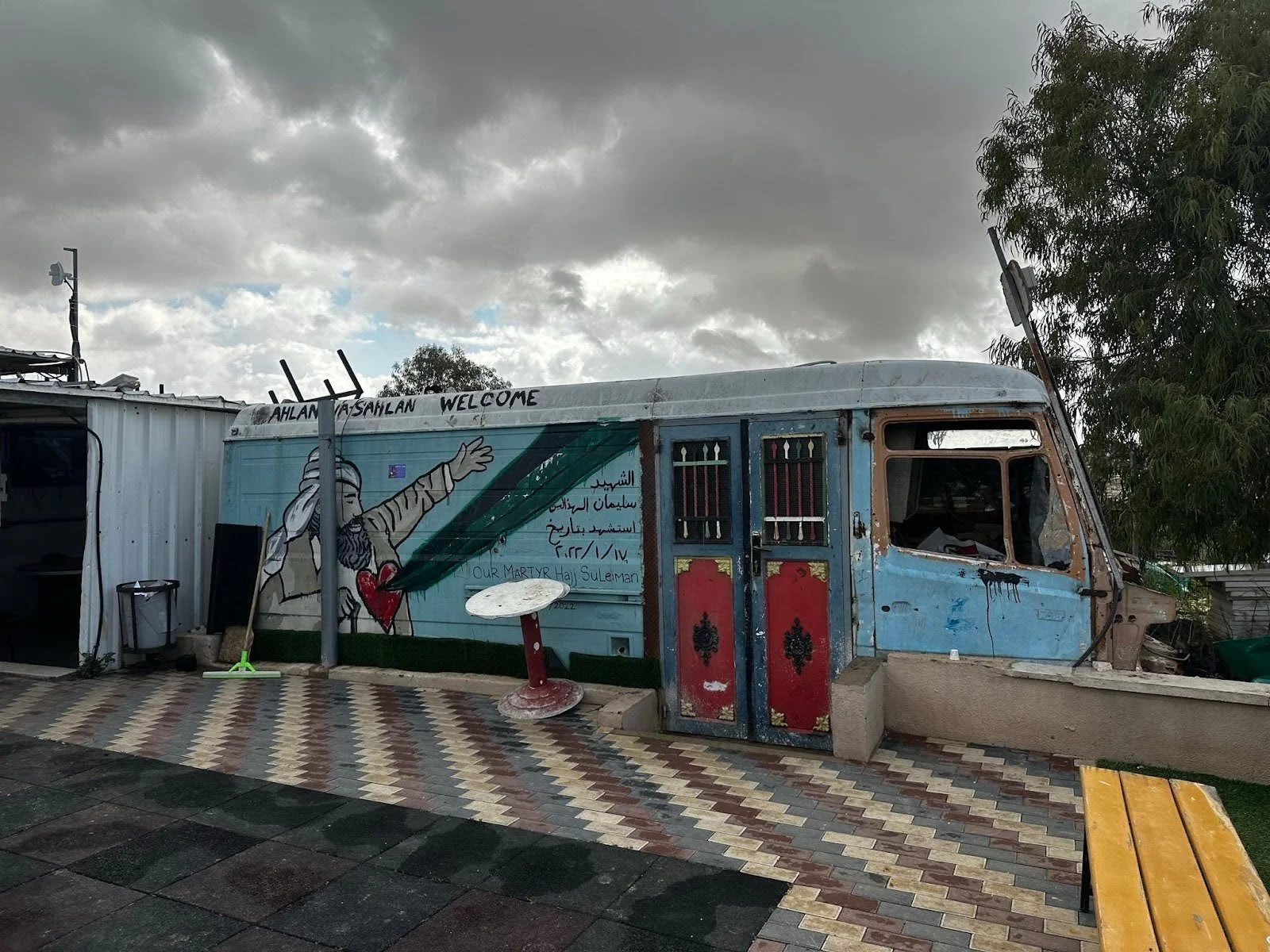
We also couldn’t deny the scent of cardamom. Such brutal conditions the Palestinian people are enduring, but they’re enduring! Every olive grove and rain basin testifies to their persistence. As we pulled into Umm Al-Khair, a Palestinian village of 37 families in the foothills of Hebron, the scent only grew stronger. We were warmly greeted by our hosts from the village. They brought us into their library, fed us lunch, and offered us coffee from their limited supply of water. It was beyond humbling for people scraping out existence amidst the manufactured scarcity of apartheid to share with us as generously as they did.
They then took time to share their struggle to stay on the land. We hadn’t noticed when we came in, but they pointed out to us that only a few meters away on the other side of barbed wire fence were a collection of trailers, not unlike what we’d see in a trailer park here in the states. The trailers belonged to Israeli settlers. They had intentionally placed them right up against the living quarters of the Palestinian families of Umm Al-Khair. We continued talking, but I began to feel like we were being watched.
They then shared with us that we were witnessing in real time Israel’s strategy for colonizing the West Bank and driving out the Palestinians. Israel, they told us, has been funding settlers to enclose Palestinian lands, harass and kill Palestinian families, and steal and destroy Palestinian agricultural lands, trees, and animals. In the case of Umm Al-Khair, they used to support themselves with over 5,000 goats and sheep. Since the settlers encroached on their lands they are down to about 1,000 between the slaughter and stealing. Not only that, but they no longer have access to the fields where their animals used to graze. Without that source of food, they’re forced to go into town and purchase feed, further burdening the village.
The violence isn’t directed only at the animals. The settlers had recently killed the father of one of our hosts. Another member of the village shared that in the last year the settlers had shot and killed his brother. It happened in broad daylight, was caught on video, and was witnessed by multiple members of the international community who were present. He then told us that the police released the settler from custody that very night, and that justice has never been served. He said to us, “You ask me what I need? I need justice for my brother… …the situation here is very bad.”
This too represents a strategy that Israel employs to displace the Palestinians. Settlers wreak havoc and violence on Palestinian villages with the approval and protection of the Israeli police and military. When the man whose brother was killed recounted his story, he told us that at the time of his brother’s killing he and others from the village were actually arrested as well. We found this to be an unsettlingly common theme amongst the Palestinians we spoke to. Everyone had a story of imprisonment or unjust treatment.
The Israeli military oversees settler violence, but they commit their own in overt and covert ways. For instance, they put impossible regulations on how Palestinians inhabit their land through the permit regime, which writer Cheryl Rubenberg describes as Israel’s most effective instrument of “suspended violence,” or, the violence that unfolds slowly in the everyday. For instance, the speakers told us of the perpetual struggle to exist when Israel makes it impossible to obtain permits for a wide range of activities, including travel, planting trees, and building new structures on their land. Meanwhile, settlers are thoroughly funded for fast and aggressive expansion.
After such a thorough education in the machinery of apartheid and ethnic cleansing, many of us needed to step outside into the sunlight to take a breath. When even a narration of the conditions here falls that heavily on my body, I find it hard to imagine how the people of Umm Al-Khair find it within themselves to continue struggling for existence on their land. As perhaps the beginning of an answer to my wondering, the children of the village invited us to come play soccer with them.
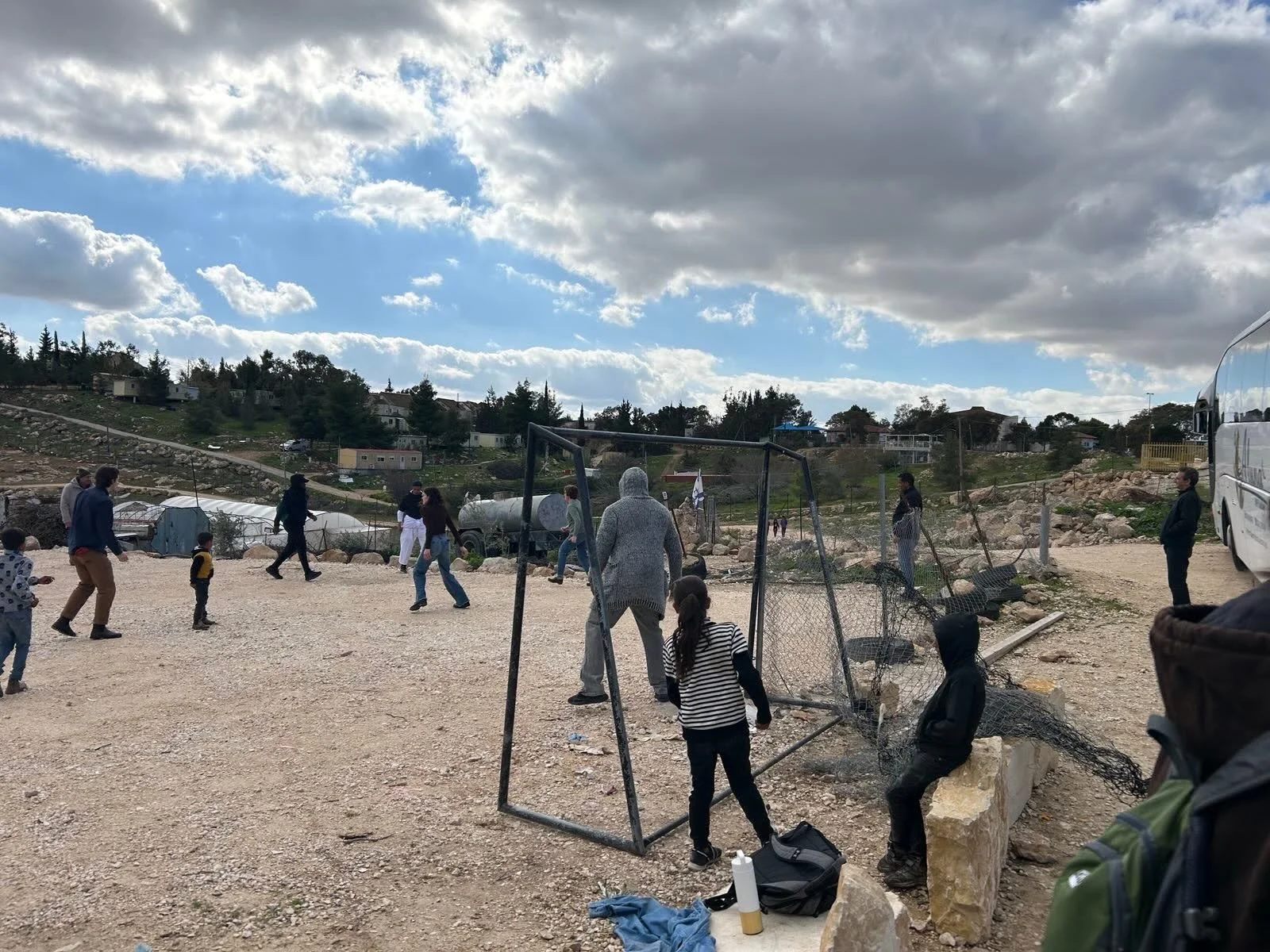
The field they were playing on shocked me. The goals had no nets, and barbed wire surrounded the portions of the field not bordered by the road. Beyond the far goal and over the barbed wire lay land occupied by the settlers, who hadn’t made an appearance in our time there. We divided up into teams and started playing. Many, like myself, probably stood around laughing more than we made any meaningful contribution. Some of the kids from the village really outclassed the rest of us. A while in, one of us accidentally kicked the ball out into the land occupied by settlers.
The mood, jubilant only a moment ago, shifted. As one of the kids from the village took off for his home to grab another ball, it dawned on me that an attempt to go retrieve the ball would likely be met with violence. We wrapped up the game not too long after that. For the kids, playing under the threat of violence seemed normal. They didn’t even think to chase the ball, they just went to get a new one. Today they had one, but what about the ball after that? I thought about the privilege I had at their age to be carefree, to chase a ball or frisbee into someone else’s yard.
We gathered in the middle of the field to say our goodbyes and thank everyone for their hospitality. As we did, a door to one of the settler’s trailers opened. A man stepped out holding a very expensive looking camera and began taking pictures of us. A few of us reached for our cameras to film him back, but we were quickly reminded that escalating the situation would only mean consequences for the people of Umm Al-Khair. We had to remember that the settlers have the full backing of the Israeli military. So we finished our goodbyes and quickly shuffled onto the bus.
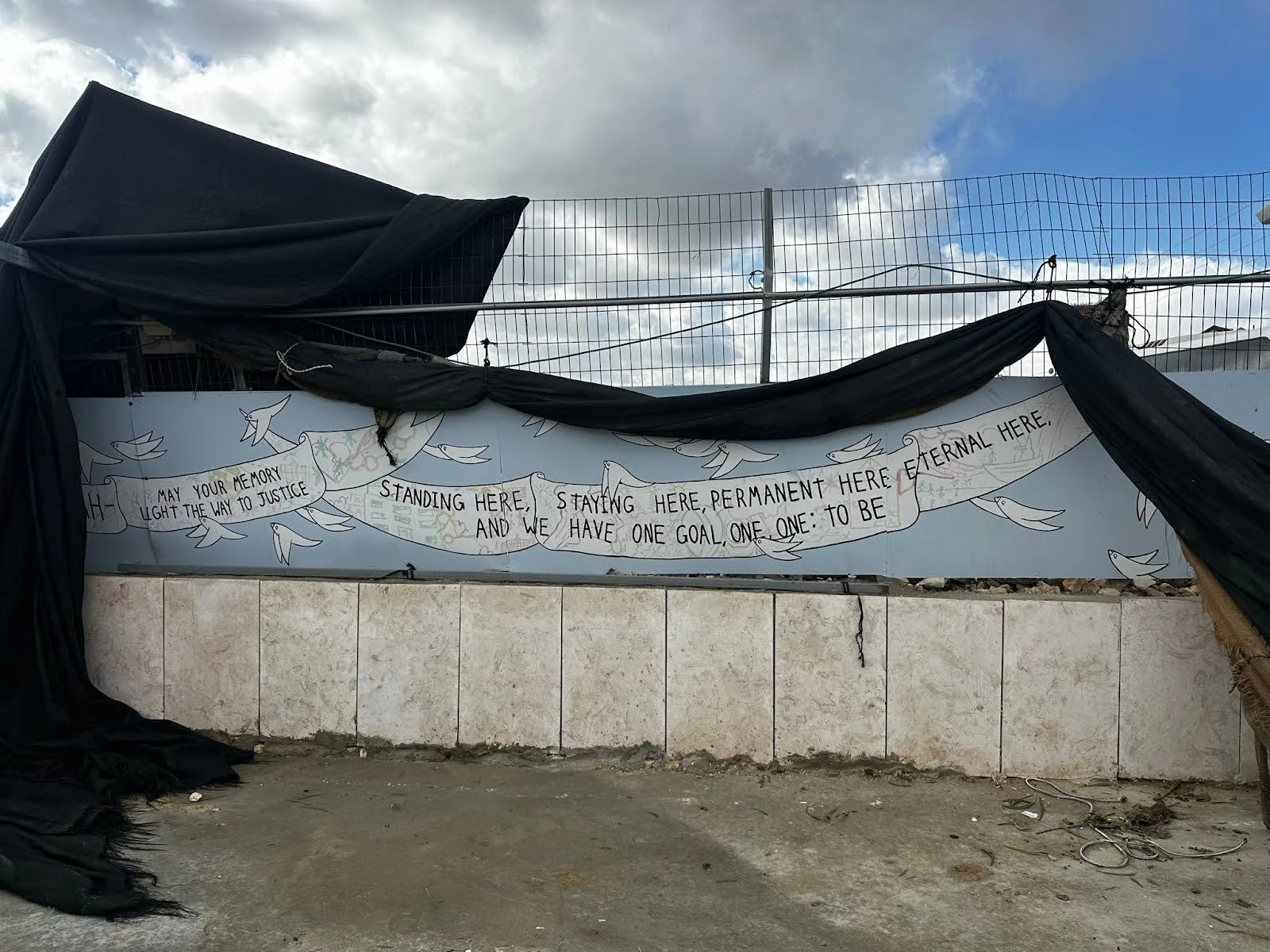
Though our time in Umm Al-Khair laid bare some of the atrocities of apartheid, I didn’t come away with only despair in my heart. Rather, the words painted across one of their walls sticks with me. “Standing here, staying here, permanent here, eternal here, and we have one goal, one, one: to be.” As an American Christian I receive these words as a call into costly solidarity. What sacrifices must I make, what changes must I undergo, what actions must I take in order for my siblings in Palestine to simply be? In the foothills of Hebron I renewed my commitment to a world where children everywhere are free to chase down soccer balls wherever they go.
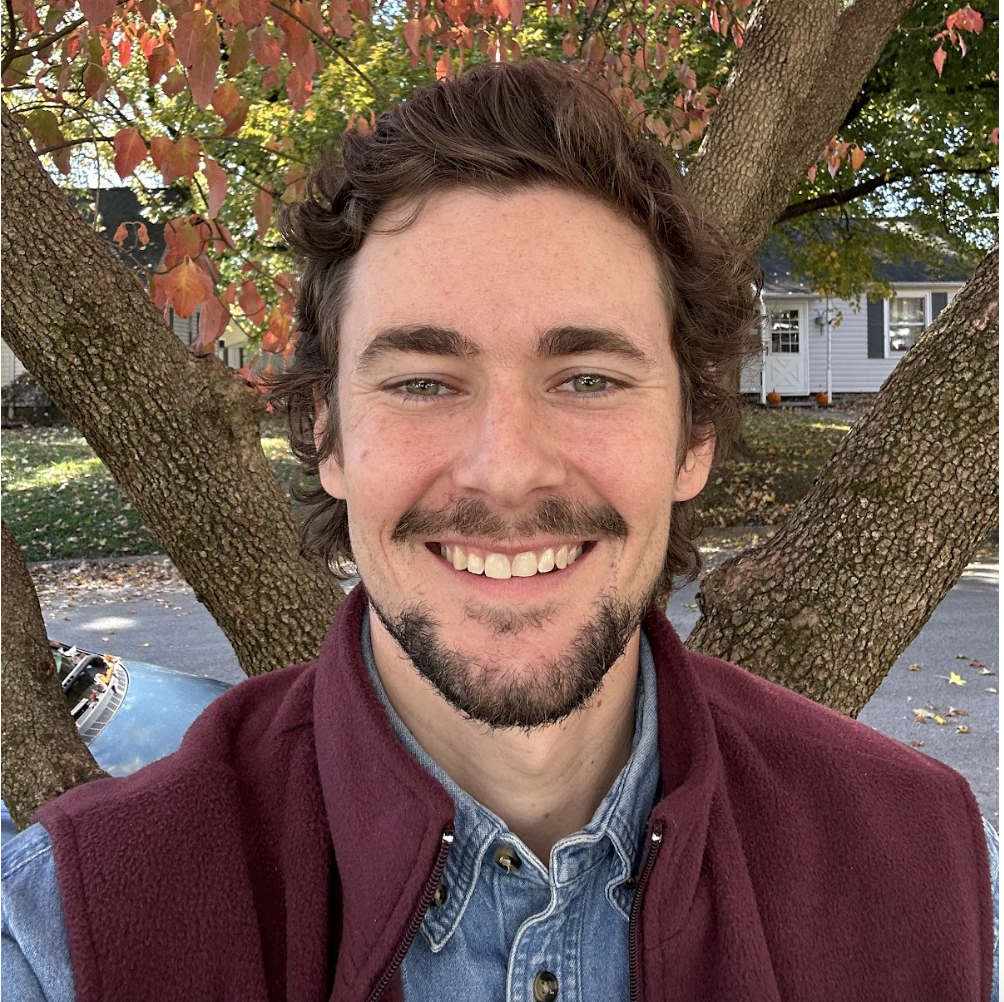
Nate Paulin-Wieland is a hospital chaplain living on Illiniwek land currently known as Greenville, Illinois. He serves the Illinois Great Rivers Conference of the United Methodist Church on the Board of Church and Society and as the Caretakers of God’s Creation Coordinator.